01
Why genealogies matter
Ancient genealogies are more than lists of names. This book treats them as maps of identity, inheritance, conflict, and cosmic order, and explains the work they do in apocalyptic and mythic literature.
Daniel Harrow
The Watcher Genealogies Mapped
A guide to fallen angel lineages in ancient texts
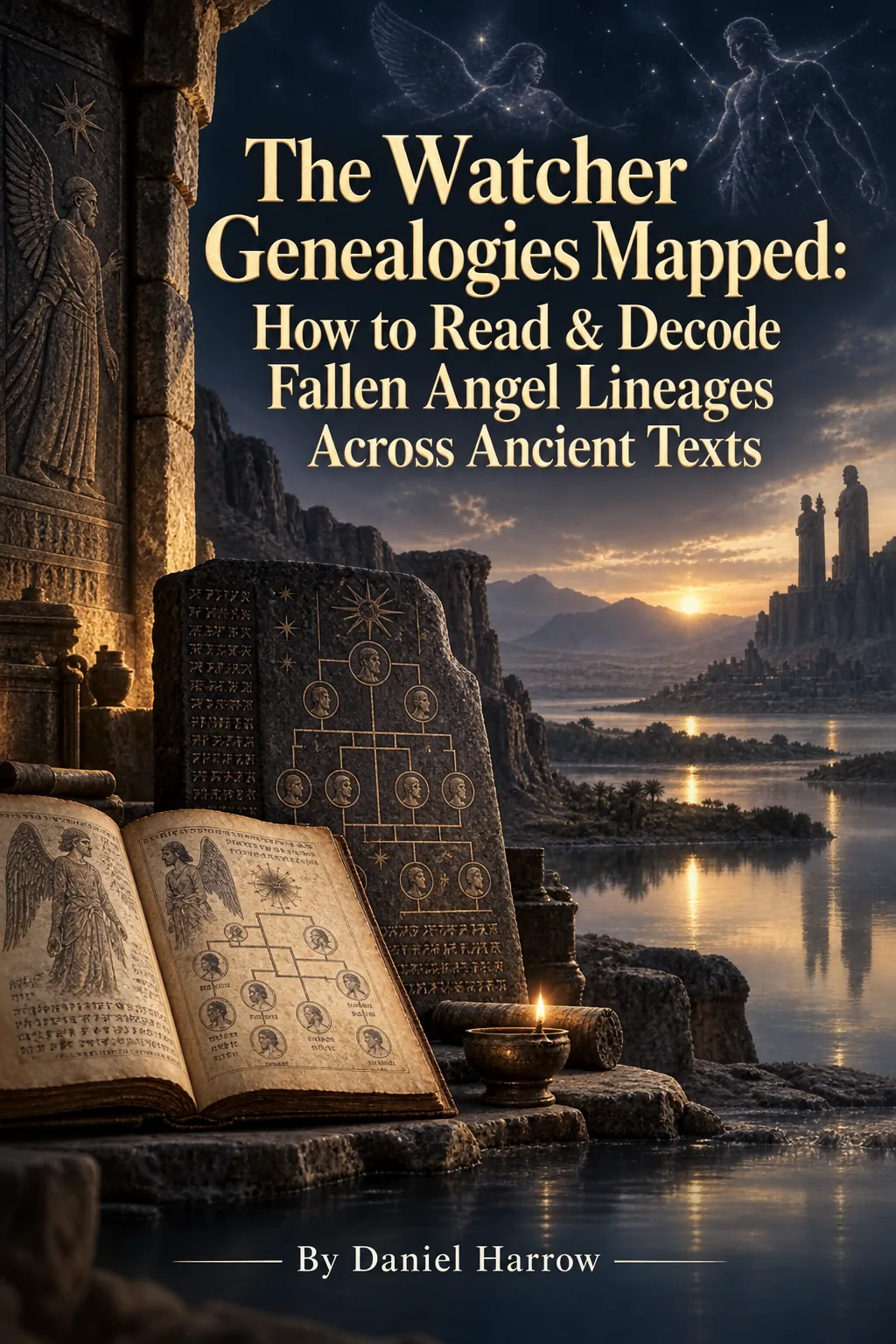
The Watcher Genealogies Mapped: How to Read & Decode Fallen Angel Lineages Across Ancient Texts
By Daniel Harrow
A structured, source-grounded framework for reading the Watcher and Nephilim genealogies of 1 Enoch and related texts. Build each lineage step by step, weigh names across languages and manuscripts, and keep evidence clearly apart from speculation.
What this book explores
Watcher genealogies are mapped here as a working practice, not a trivia exercise. Each theme gives you a piece of the method: a way of reading names, lines, and relationships so they hold up when you check them against the texts.
01
Ancient genealogies are more than lists of names. This book treats them as maps of identity, inheritance, conflict, and cosmic order, and explains the work they do in apocalyptic and mythic literature.
02
Centered on 1 Enoch and related ancient traditions, the book shows you how to identify the sources behind the Watcher and Nephilim lineages and to notice later retellings reshaping earlier stories.
03
Learn how to study 1 Enoch names and relationships with a method you can reuse: build a genealogy step by step, from explicit relationships to plausible connections to clearly labeled guesses.
04
Evaluate Watcher names rather than trusting them at face value. Cross-check competing versions across languages and manuscripts, and read names symbolically without forcing meanings the texts will not support.
05
Trace the Two Hundred, the collective body of the Watcher tradition, and examine the named Watchers, their cosmic roles, and how their descent is told across the sources.
06
Explore the Nephilim, the second generation, and the Book of Giants genealogy material, then see how Jubilees reshapes and reframes the inherited story of the Watchers.
Why readers choose it
Plenty of writing on fallen angels promises hidden bloodlines and certainty the sources cannot give. The Watcher Genealogies Mapped takes the opposite approach: it is a structured research tool for readers who want to test interpretations against the texts themselves.
Its method keeps evidence and speculation apart. Identify the source behind each claim, map the names and relationships you can actually see, and record where manuscripts disagree. If you have tried to study the fallen angels genealogy traditions of ancient texts and hit a wall of contradictory names, this is the disciplined alternative: reconstruct a lineage step by step, and let the sources carry the argument.
“Follow the names. Map the lines. Decode the tradition.”
Whether you are studying 1 Enoch, the Book of Giants, Jubilees, or the wider literature surrounding them, the guide helps you read across traditions while keeping the genealogy in view.
Who it is for
If any of these sounds like you, the method in The Watcher Genealogies Mapped was built with your notes and name confusion in mind.
Reader questions
Classify before you connect. For every relationship, decide whether it is stated explicitly in the text, plausibly connected, transmitted with variant readings, or speculative. The Watcher Genealogies Mapped turns that classification into a step-by-step method, so a Watcher genealogy you reconstruct is only ever as strong as its textual evidence.
They are connected, but not by a single fixed chart. Across ancient Jewish texts, who counts as a Watcher, how descent passes from the Watchers, and how the Nephilim relate to the giants and later generations shift between sources and interpretive traditions. The book maps those competing versions side by side so you can see where they agree and where they diverge.
Strongly. Names carry over between languages by transliteration, change as texts are copied, and vary between manuscript witnesses, so the same figure can appear under different spellings. The book shows you how to compare languages and manuscripts deliberately before you build an argument on a name.
A related witness, not a duplicate. The Book of Giants preserves its own material about the giants and the second generation, and its surviving fragments can be compared with 1 Enoch and other traditions rather than read as a simple retelling. The book treats it as a source with its own genealogical contribution.
With continuity and reframing at once. Jubilees carries the inherited story forward while retelling it: familiar figures return with changed detail and emphasis. The book identifies the points of continuity and reframing so you can go back to the texts and compare them directly.
A collective designation. In the Watcher tradition, the Two Hundred is the wider body of Watchers whose descent stands behind the better-known named leaders. The book traces the Two Hundred collectively and examines the names and cosmic roles attached to them in the sources.
Yes, if you test them first. The approach this book takes is to check every proposed symbolic meaning against the language of the text, its literary context, the manuscript evidence, and the limits of what the text says, and to prefer a reading that survives those checks over a striking one that does not.
Use a comparison grid. For each passage, record the source, the names in play, the relationships claimed, the narrative function they serve, the textual uncertainty, and how later retellings rework the scene. The Watcher Genealogies Mapped builds that grid into a practical workflow for reading across the three texts.
Book and author details
The Watcher Genealogies Mapped is by Daniel Harrow, written for readers of the Watcher and Nephilim traditions of 1 Enoch, the Book of Giants, and Jubilees.
If the Watcher and Nephilim traditions have ever felt like a tangle of names, this guide hands you a way through them: step by step, source by source, with the lineage always in frame. Read it beside your copies of 1 Enoch, the Book of Giants, and Jubilees, and follow the names.